
Traveling With Chronic Diarrhea: 11 Tips That Actually Help
A vacation is supposed to give you a break from your routines. But when you live with chronic diarrhea, your normal routines may be the only things keeping you feeling safe and in control.
At home and in your daily life, you know which foods are least likely to cause trouble, where the bathrooms are, and how much time you need in the morning before you can safely walk out the door. Travel replaces those comforting details with stressful airport lines, unfamiliar meals, traffic jams, awkward public situations, and the one question that can overshadow everything else: what happens if I suddenly need a bathroom?
That uncertainty can make travel harder, but it doesn't have to make it impossible. A thoughtful plan and some real, practical advice can reduce the risks and some of the worry that comes with them. At the same time, managing diarrhea on a trip shouldn't become a substitute for understanding why it keeps happening.
These eleven tips can help you when you're on the go, and when you're searching for medical answers to what's causing your diarrhea, bloating, and abdominal discomfort.
Before You Go: Preparing for Travel With Chronic Diarrhea
1. Pack a Chronic Diarrhea "Just in Case" Kit and Keep It With You
Start with the supplies you'd want during the exact situation you hope won't happen:
Unscented cleansing wipes and tissues
Hand sanitizer or sanitizing wipes
A barrier ointment such as Calmoseptine, whose label specifically covers skin irritation caused by diarrhea
A portable bidet or peri bottle, which many people find gentler than repeated wiping during a flare
Any medications your provider has recommended, including OTC aids like loperamide (Imodium) and bismuth subsalicylate (Pepto-Bismol)
Oral rehydration packets, which are not the same as sports drinks (see Tip 6)
A compact digital thermometer (see Tip 8 for why)
A full change of underwear and clothes
Sealable bags for soiled clothing
Disposable underwear or absorbent protection, if that would make a long trip feel more manageable

Keep the kit in your carry-on, day bag, or car, not in checked luggage. Prescription medications should generally stay in their original labeled containers, especially during international travel, and it's worth packing enough to cover the trip plus a few extra days in case of delays.
The goal isn't to assume something will go wrong. It's to know that one difficult moment won't leave you without options.
Want a comprehensive packing list? Download the Gemelli IBS & SIBO Travel Checklist.
2. Test-Drive Your Travel Plan Close to Home Before a Long Trip
Before a big trip, take the bag you just packed somewhere low-stakes.
Spend a day out using the same kit, foods, medication strategy, and schedule you expect to use while traveling. A day trip to a nearby town, a long afternoon at a museum, or a few hours at a park. Far enough to reveal problems, but close enough that going home stays easy.

You may find that your kit is too bulky to carry comfortably, that the spare clothing is buried under everything else, that you need more time after breakfast before heading out, or that you feel better scheduling activities later in the day. It's better to learn that thirty minutes from your own bathroom than three time zones away.
This isn't a test of whether you're "ready" to travel. It's a rehearsal that helps you make adjustments and feel more comfortable when the time comes.
3. Make a Chronic Diarrhea Treatment Plan With Your Provider Before You Leave
The best time to decide how you'll handle a flare is before you're standing in an unfamiliar pharmacy comparing medication labels.
A few weeks before you leave, ask your provider:
Whether an as-needed antidiarrheal medication is appropriate for you, and when you shouldn't take it
Whether any regular medication timing needs to change across time zones
Whether your destination and medical history justify carrying treatment for travelers' diarrhea
Which symptoms should send you to urgent care
Whether you need a letter documenting your condition, prescriptions, or medical supplies
For international travel, check whether your destination restricts any medications you plan to carry, and keep an updated list of your doses, allergies, and medical conditions.
Bonus Tip: Use TSA Cares

If you're flying with medical supplies, liquids such as oral rehydration packets, or anything else you'd rather not explain in front of a line of people, TSA Cares can help. It's a free helpline that arranges screening assistance for travelers with medical conditions. Call (855) 787-2227 or use the online request form at least 72 hours before you fly. TSA also offers an optional notification card you can hand to an officer to explain your situation discreetly.
You can find more information at https://www.tsa.gov/travel/tsa-cares
Getting There: Managing Loose Stools and Urgency in Transit
4. Scout Restrooms Ahead When Urgent Bowel Movements Are a Risk
Don't wait until an emergency to figure out where the nearest restroom is.
Before a flight, look at the airport map and find the restrooms. Airport websites provide these, and Google Maps has indoor layouts for many large airports. Just scroll in close enough to see them. Also, if possible, booking an aisle seat makes it easier to snag an empty restroom while in-flight.
On a road trip, identify rest areas or restroom-friendly businesses along the route rather than assuming you'll find one when you need it. Apps like iExit can tell you what's at upcoming highway exits, including rest areas, before you have to decide whether to pull off.
When you arrive at a museum, restaurant, or attraction, scope out the restrooms early. If you have to leave your comfort supply kit in the car, ask about re-entry policies for extra peace of mind.
The Crohn's & Colitis Foundation's free We Can't Wait app maps publicly accessible restrooms and is open to anyone with urgent needs, not only people with inflammatory bowel disease (IBD). Listings depend partly on what other users add, so use it to scout ahead rather than count on it.
This overall “be prepared” thinking applies to the trip as a whole. Well-planned connections, flexible reservations, and a less crowded itinerary all cut down on situations where you feel trapped. Always build in more time than you think you need, even if it’s just to rest and stay regulated.
5. Know Your Restroom Access Rights When Diarrhea Can't Wait
Sometimes the nearest restroom isn't a public one. Many states have passed a version of the Restroom Access Act, often called Ally's Law, which lets people with qualifying conditions use an employee-only restroom when no public one is available. The details vary quite a bit, so check the states you're visiting before you go.

That same We Can't Wait app carries a digital restroom access card and a state-by-state guide to the law. Your provider can also write a short letter describing your need for urgent access, which may help in places the law doesn't reach.
It also may help to tell one trusted travel companion what you're dealing with. You don't need to give everyone a medical history, but having one person who understands why plans may change takes away the burden of inventing excuses.
6. Rehydrate the Right Way When Diarrhea Won't Stop
Diarrhea causes the body to lose both fluid and electrolytes. Replacing what you've lost matters, especially for older adults, people with ongoing medical conditions, and anyone having repeated watery stools or vomiting.
For mild diarrhea, familiar fluids may be enough. When you're losing more fluid than that, an oral rehydration solution, or ORS, might be a better tool. An ORS contains water, sugar, and electrolytes in amounts designed to help the intestine absorb fluid well.

The label is what matters here, not the shelf it sits on. Look for a product actually described as an oral rehydration solution or oral rehydration salts, such as Pedialyte powder packs, DripDrop ORS, or TRIORAL packets. Many popular electrolyte powders and sports drinks are not formulated the same way and they don't necessarily carry the sugar and sodium proportions used to treat dehydration from diarrhea. Powdered ORS packets are easy to carry and mix with water, following the instructions on the package.
Be careful with very sugary drinks, including large amounts of soda or juice, because concentrated sugar can sometimes make diarrhea worse.
7. Keep Travel-Day Eating Familiar When Food Goes Right Through You
The morning of a flight isn't the time to test a new protein bar, skip food entirely, or find out whether a large iced coffee still bothers you. Choose foods that have been reasonably predictable for you at home. Common triggers include large amounts of caffeine, alcohol, fried or fatty foods, and sugar alcohols such as sorbitol or xylitol.
Smaller, more frequent meals help some people feel more in control before a long stretch without easy bathroom access. But it isn't universal advice, and here's why.
Between meals, the small intestine runs a wave of contractions sometimes called the cleaning wave, or migrating motor complex. It sweeps leftover food, debris, and bacteria toward the colon, and it only runs while you aren't eating. Every meal and snack interrupts it and restarts the cycle. Research from Dr. Mark Pimentel's group at Cedars-Sinai has found that these waves occur less often in people with irritable bowel syndrome (IBS) who also show signs of bacterial overgrowth.
That doesn't make snacking harmful, but it does mean constant grazing isn't automatically the gentler option. If you normally eat at predictable times with real gaps in between, holding that pattern may serve you better than switching to all-day nibbling. Go with what has actually worked for you.
Packing a few familiar foods helps either way. It keeps you from having to choose between skipping a meal and eating something unpredictable.
If you already know that certain high-FODMAP foods bother you, use that knowledge when you're on the go. But a trip is probably the wrong time to start any new diet from scratch. Don't attempt an untested diet change, even a well-meaning one, right before you travel.
If Something Changes: Warning Signs and When to Seek Medical Care
8. Know When Travelers' Diarrhea Is a Different Problem Than Your Usual IBS-D or SIBO
Travelers' diarrhea is a new infection you pick up during travel. It isn't the same thing as your usual IBS with diarrhea (IBS-D), small intestinal bacterial overgrowth (SIBO), intestinal sulfide overproduction (ISO), or other ongoing condition, and it may need a different response.

The hard part is noticing. Someone who already lives with loose stools or urgency may treat a sudden change as "just my normal stomach," even when the symptoms are more intense, come with a fever, or are caused by an infection. This is where that thermometer earns its space in the bag.
Fever, blood in the stool, or symptoms clearly worse than your baseline all suggest something other than your usual pattern, and should be taken seriously. The FAQ at the end of this article covers prevention, treatment, and when antibiotics come into it.
9. Know When Chronic Diarrhea Needs Medical Care, Not Just Management
Not every episode of diarrhea should be handled the same way.
Seek prompt medical care if you have:
Blood in the stool, or black, tarry stools
A high fever
Severe or worsening abdominal pain
Repeated vomiting, or trouble keeping fluids down
Signs of significant dehydration
Confusion, fainting, or unusual weakness
Symptoms dramatically different from your usual pattern

Before you leave, save contact information for a well-regarded clinic or hospital near your destination, along with your health insurer's international assistance number, and keep them somewhere you can reach without an internet connection. For remote or international travel, consider health or travel insurance that includes medical assistance and evacuation coverage.
Knowing where you'd go doesn't mean you expect to need it. It means an urgent situation won't start with an internet search in an unfamiliar place. Better yet, share the plan with whoever you're traveling with, so you know someone else has your back.
Beyond This Trip: Finding What's Causing Chronic Diarrhea
10. Track Your Daily Diarrhea Patterns Without Letting Them Run Your Life
Chronic diarrhea isn't always predictable, but if you look closer, there may be some patterns. Some people are most vulnerable in the morning. Others notice urgency shortly after eating, drinking coffee, taking medication, or going several hours without food.

For a week or two, pay attention to when symptoms happen and what came before them. You don't need an elaborate spreadsheet. A note on your phone can help you spot which times of day are most active, how long you generally need after eating before leaving home, whether certain meals or medications reliably change things, and whether stress or poor sleep makes urgency worse.
Then use what you learn. Schedule important plans and appointments during your more predictable hours. Try not to stack errands or outings right after a meal that often sets off symptoms. The goal isn't to organize your entire life around your gut. It's to use what you know about your body to create a little more room for everything else.
11. Don't Let Travel Planning Replace Finding Your Chronic Diarrhea Causes
Every tip above can make chronic diarrhea easier to manage. None of them explains why the diarrhea keeps happening.
Chronic diarrhea has many possible causes, including celiac disease, inflammatory bowel disease, bile acid diarrhea, microscopic colitis, medication effects, post-infectious IBS, and conditions involving microbial overgrowth or excess microbial gas production, such as SIBO or ISO. The right evaluation depends on your symptoms, medical history, and risk factors.
One detail that people often overlook is whether your symptoms began after food poisoning or another gut infection. Research has found that roughly 1 in 10 people develop IBS within a year after infectious enteritis, and the raised risk can last beyond that point. This is known as post-infectious IBS.
Research led by Dr. Mark Pimentel and the Medically Associated Science and Technology (MAST) Program at Cedars-Sinai has helped describe a likely biological pathway behind that connection. After certain bacterial infections, the immune system produces antibodies against a toxin called CdtB. In some people, the immune response also produces anti-vinculin antibodies, which are associated with changes in normal gut nerve and muscle function. Tell your provider if that pattern sounds familiar, even if the original illness happened months or years ago.
Two tests offered by Gemelli Biotech can help answer specific questions within a broader evaluation.
IBS-Smart is a blood test that measures anti-CdtB and anti-vinculin. Elevated levels can support a diagnosis of IBS-D or IBS with mixed bowel habits (IBS-M) and are consistent with a post-infectious pathway. A negative result doesn't rule out IBS. It means this particular antibody pattern wasn't detected.
Trio-Smart is the only at-home breath test that measures all three of the primary fermented gases: hydrogen, methane, and hydrogen sulfide. Those gas patterns can point toward small intestinal bacterial overgrowth, intestinal methanogen overgrowth, or intestinal sulfide overproduction. Hydrogen sulfide is particularly relevant to chronic diarrhea and isn't measured by conventional one- or two-gas breath tests.
These tests don't look at every possible cause of chronic diarrhea. Combined with an evaluation by your provider, though, they can provide useful biological data about causes that might otherwise go unexplored.


The Goal Is More Than Getting Through the Trip
One last tip: there's no shame in planning around chronic diarrhea. Pack the extra clothes. Choose the aisle seat. Find the bathroom before you need it. Tell a friend what you’re dealing with. Those adjustments can make the difference between staying home and taking part in your own life.
But remember that coping skills can sometimes work so well that they begin to hide what the symptoms are costing you. Diarrhea that has lasted four weeks or longer warrants an investigation, not just a better system for living around it.
You deserve answers, so never stop looking for them. A real explanation gives you and your provider something specific to treat or manage, instead of just a frustrating set of symptoms. The goal isn't getting through a trip without an accident. It's understanding your symptoms well enough that no trip feels like a risk assessment.
Frequently Asked Questions
How long does diarrhea have to last before it's considered chronic?
Four weeks or longer is the usual dividing line. Anything beyond that point is worth talking through with a healthcare provider, no matter how manageable it feels day to day.
Why does it feel like food goes right through me?
Fast transit, meaning food and fluid moving through the gut more quickly than usual, is a common experience with chronic diarrhea. It can have a number of causes, including IBS-D, bile acid diarrhea, and conditions associated with microbial overgrowth. The sensation itself doesn't identify the cause, which is why an evaluation is useful.
Can food poisoning really cause diarrhea that lasts for years?
It can. Research has found that roughly 1 in 10 people develop IBS within a year of an episode of infectious enteritis, and the raised risk can continue beyond that. This is called post-infectious IBS, and the timeline is worth mentioning to your provider even if the original illness was a long time ago.
Can a low-FODMAP diet help IBS-D or chronic diarrhea?
FODMAP stands for fermentable oligosaccharides, disaccharides, monosaccharides, and polyols, a group of carbohydrates that ferment in the gut and can trigger gas, bloating, and diarrhea in some people. A low-FODMAP diet limits them temporarily. The American College of Gastroenterology recommends only a limited trial for IBS symptom relief, with foods added back in over time to find your own tolerances. It can ease symptoms for some people, but it doesn't address what's causing them, and it’s usually not designed to be permanent.
How can I lower my risk of travelers' diarrhea?
Choose food that's thoroughly cooked and served hot, drink from unopened factory-sealed containers, skip ice unless you know it was made with safe water, and peel raw produce yourself. Wash your hands before eating, or use sanitizer with at least 60% alcohol. These steps lower your exposure but can't remove it, and even careful travelers still get sick.
When does travelers' diarrhea need antibiotics?
The CDC sorts it by how much it limits you:
Mild: Tolerable, and doesn't interfere with your plans. Antibiotics aren't recommended.
Moderate: Distressing, or disruptive to your plans. Antibiotics may be considered.
Severe: Overwhelming, or completely prevents your plans. Bloody diarrhea always counts as severe.
A provider may prescribe a standby course before you leave when your destination or limited access to care justifies it.
Can I take Imodium or Pepto-Bismol while traveling?
Loperamide, sold as Imodium A-D, can reduce urgency and how often you need a bathroom, which helps on a flight or long drive. It shouldn't be used on its own when diarrhea comes with blood or fever. Bismuth subsalicylate, sold as Pepto-Bismol, can help milder symptoms but isn't right for everyone. Check both against your prescriptions and health conditions before you go, and your doctor and pharmacist can confirm what's safe for you.
What's the difference between IBS-D, SIBO, IMO, and ISO?
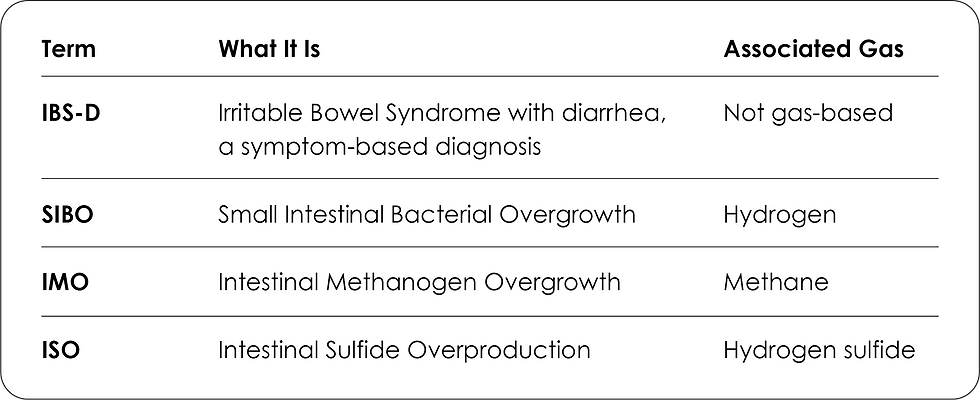
They aren't interchangeable, and more than one can be present. A breath test measures the gases and provides you data, while your provider interprets what those levels mean alongside your symptoms and history.
How do I know whether testing is worth bringing up with my provider?
If you're not sure, a short online quiz can help you think it through. Trio-Smart's breath test quiz walks through the symptom patterns that tend to make breath testing worth a conversation. There's also a free doctor discussion guide you can bring to your appointment, which helps you organize what to describe and what to ask. Neither one replaces an evaluation, but both can make a short appointment more productive.
Editor’s Note: The publisher of this blog, Gemelli Biotech, is the maker of Trio-Smart and IBS-Smart, and therefore has a financial interest in those products. Gemelli Biotech has no financial relationship with the other products, services, or apps named above, and doesn't endorse them or guarantee their results. They're mentioned as examples because readers often ask for specifics, and other options may work just as well. Always read labels, follow package directions, and check with your healthcare provider or pharmacist before adding a new product, especially if you take other medications.


